Short answer
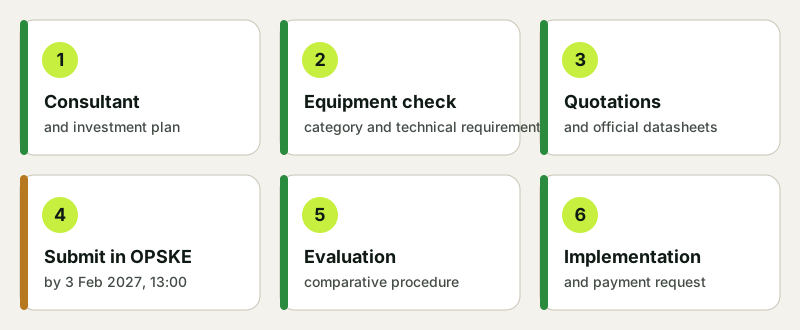
Applications for the 2026 Farm Improvement Plans are submitted electronically in the OPSKE system by 3 February 2027, 13:00. Before you apply, check four things: that you have an admissible 2025 Single Aid Application, that the equipment meets the technical requirements of its category, that you have not started the investment in a way that breaks the 80% limit, and that you hold itemised quotations and official technical datasheets. Your consultant has the final say.
In our previous article, “2026 Farm Improvement Plans: what applies to tractor navigation systems and agricultural drones”, we covered the main options for auto-steering systems, precision spraying equipment and agricultural drones.
Here we move to the next stage: how to prepare your application file properly before submitting, and what to check so that mistakes do not affect the eligibility of your investment.
Choosing a machine or collecting a quotation is not enough. You must confirm that the equipment meets the technical requirements of the call, that the investment is justified by the needs of your holding, and that the conditions of the programme are met.
Key dates and call details
The call covers three interventions of the Common Agricultural Policy Strategic Plan (CAP SP) 2023–2027:
- Π3-73-2.1: Farm Improvement Plans that contribute to competitiveness.
- Π3-73-2.2: Investments on farms that contribute to water saving.
- Π3-73-2.6: Circular economy and energy investments on farms.
| Item | Detail |
|---|---|
| Public expenditure | €263,539,000 |
| Submission opens | 10 November 2026 |
| Deadline | 3 February 2027 |
| Closing time | 13:00 |
| Submission system | Electronically, through OPSKE |
The original deadline was 20 January 2027. It moved to 3 February 2027 with the first amendment of the call.
Note: newer changes to the framework
On 16 November 2026, Joint Ministerial Decision 293292/12-11-2026 (Government Gazette B 6871) was published. It amended the implementation framework of the three interventions. When you prepare your file, take the newer changes into account, not only the original call.
Who it is for and what to check
Eligibility depends not only on the type of investment but also on the applicant and the holding. The amendment of 16 November added a new condition:
the applicant must have submitted an admissible Single Aid Application (ΕΑΕ) for 2025.
The same amendment also reworded some exclusion cases linked to earlier investment plans and aid. If you took part in an earlier programme and your investment plan was not completed, or you have already received aid, ask your consultant to check your case before you go ahead. An eligible investment does not automatically mean that the applicant meets every participation condition.
The timetable we suggest
The official dates are fixed. The intermediate milestones in the table are our own suggestion for organising the work, so that there is time for checks and corrections.
| When | What we suggest |
|---|---|
| By the end of November 2026 | Choose a consultant, check initial eligibility and define the investment plan |
| December 2026 | Collect quotations and official manufacturer datasheets |
| First half of January 2027 | Final check of equipment eligibility and supporting documents |
| Second half of January 2027 | Finalise and submit the file, with a comfortable margin before the deadline |
| 3 February 2027, 13:00 | Submission deadline |
We do not recommend leaving submission to the last days. A missing document, a wrong technical configuration or a mismatch in the quotation takes time to fix.
Support rates at a glance
Rates depend on the expenditure category, the type of beneficiary and the area. The table shows the base rates for other farmers and areas without a special regime:
| Investment category | Base support rate |
|---|---|
| High-technology equipment (Annex 3) | 60% |
| Equipment that reduces fertiliser use and pesticide drift (Annex 4) | 60% |
| Irrigation water-saving investments | 70% |
| Energy investments, renewables and circular economy | 70% |
| Agricultural tractors, forklifts, bobcats and attachments | 50% |
Increases apply for certain categories of beneficiaries and areas, such as young farmers, the Small Aegean Islands and the Just Transition Territorial Plans areas. The rate that applies to you is calculated from the specific conditions of the call.
One important point: the support rate applies to the eligible expenditure of the relevant category, not automatically to the whole budget of the investment.
Steps for preparing your file
1. Choose a consultant and define the investment plan
The first step is to work with the consultant who will prepare your file. Together you will review:
- whether you meet the participation conditions,
- which of the three interventions your investments belong to,
- which costs are eligible and which support rate applies,
- whether the budget and equipment are justified by the productive capacity of the holding.
Do not start from a specific machine. Start from the real needs of the holding and a documented investment plan.
2. Check the eligibility of the equipment
It is not enough for a product to use modern technology or be marketed as precision farming. It must meet the technical requirements of the category it will fall under.
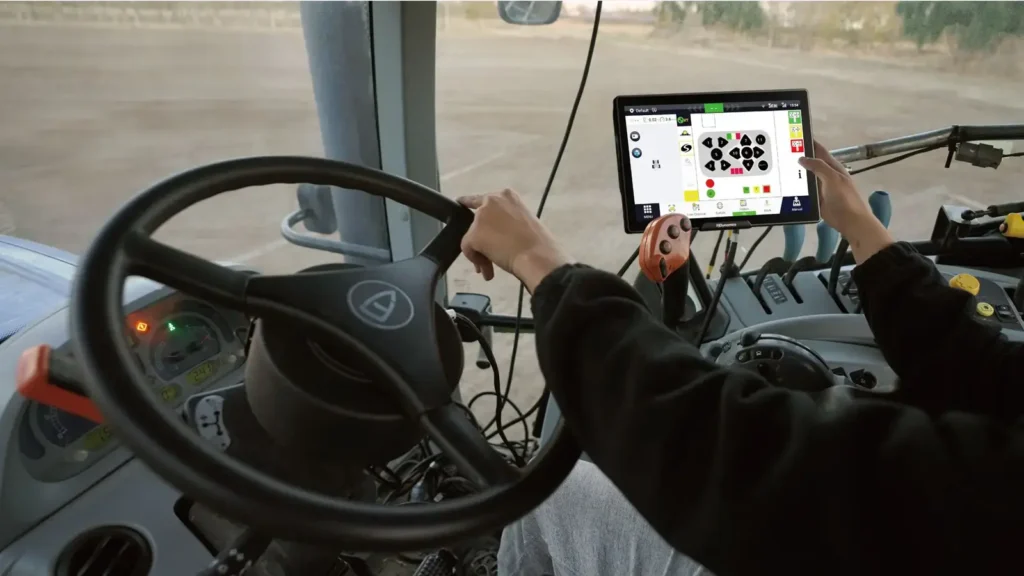
Tractor auto-steering systems (Annex 3). For high-precision GPS systems with automatic steering, retrofitted to an existing tractor, all of the following are required:
- high-precision GPS,
- real automatic steering, with automatic control of the tractor’s steering,
- documented pass-to-pass repeatability of ±3 cm or better,
- official manufacturer data for the specific model and the configuration in the quotation.
A simple GPS or a parallel-guidance system without real automatic control of the steering wheel does not meet these requirements.
Tractor ownership condition
For retrofit GPS systems with automatic steering, the tractor must be 100% owned by the applicant when the support application is submitted. This condition is specific to this category and should not be confused with the general ownership rules for other attachments.
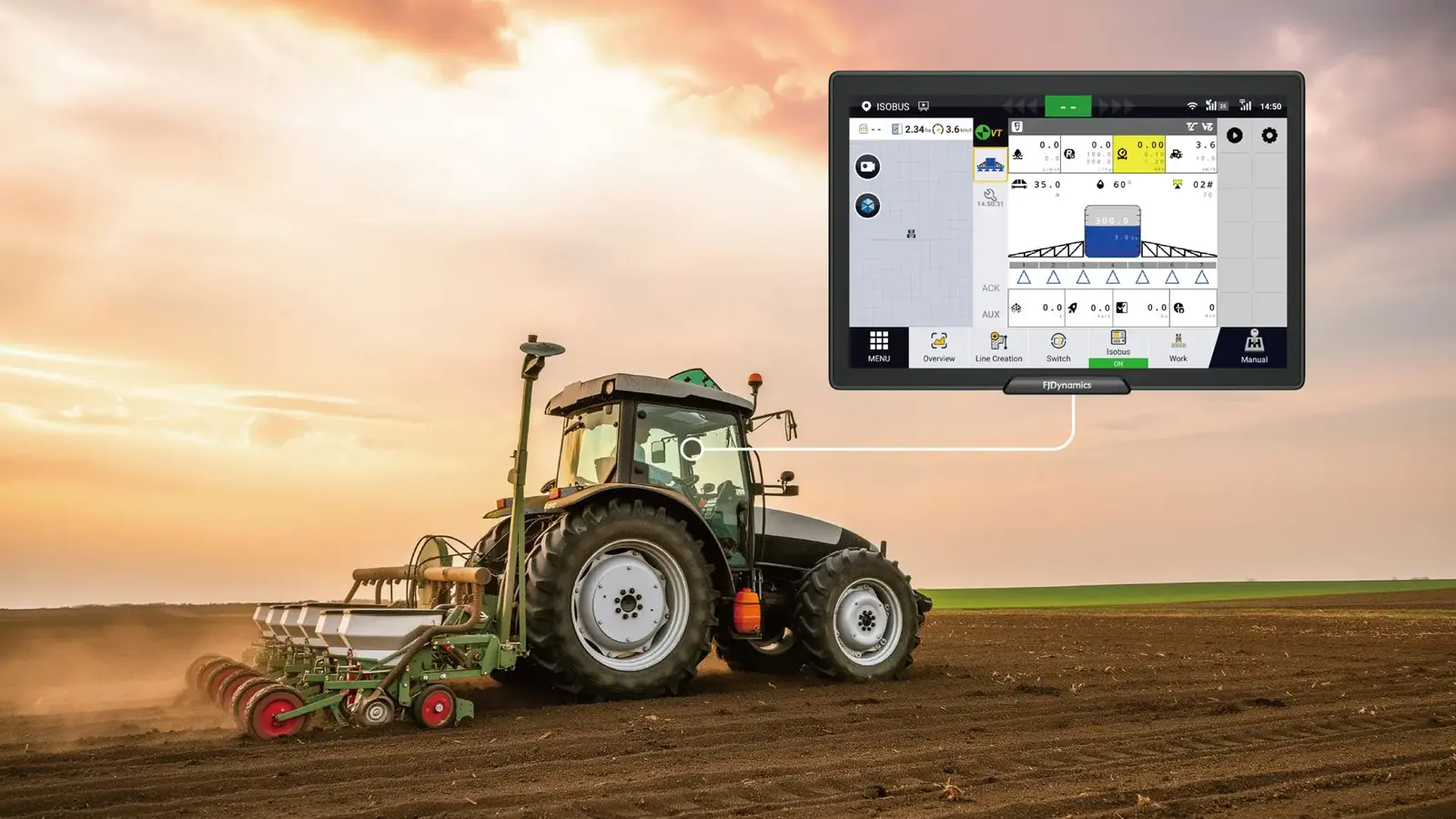
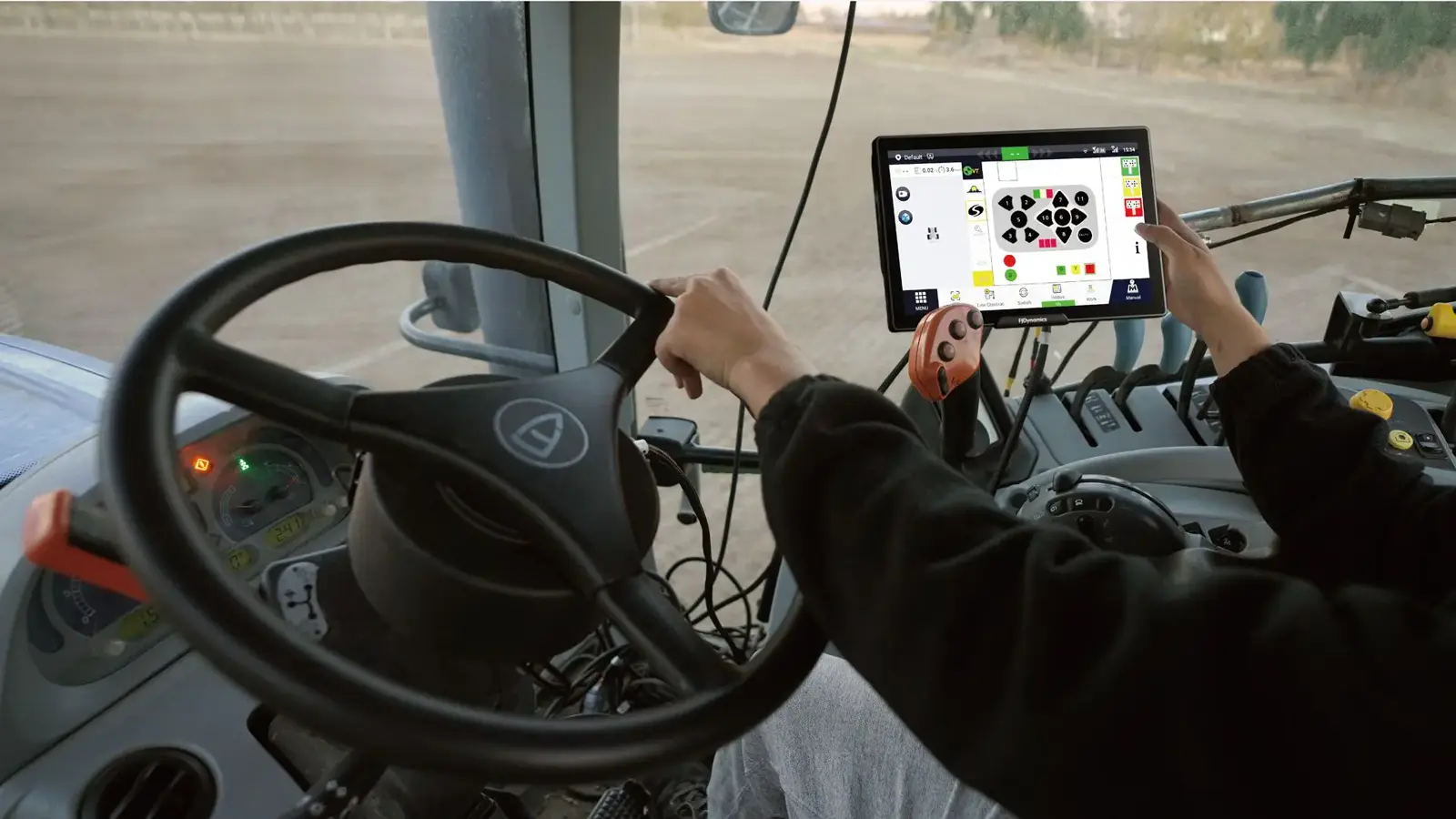
FLYDROPS FJDynamics systems. The FJD AT2 Ultra, FJD AT2 Max, FJD AT2 and FJD AT2 Lite offer GNSS and RTK with pass-to-pass repeatability of ±3 cm or better and real automatic steering. They can be options to assess under Annex 3, provided that the specific quotation and the manufacturer’s official technical documentation meet all the requirements.
- FJD AT2 Ultra: the flagship of the range, with a 16-inch display, ISOBUS and multi-machine sync, for combine harvesters and premium tractors.
- FJD AT2 Max: for holdings that need advanced functions, a 12.1-inch display and ISOBUS support.
- FJD AT2: GNSS and RTK auto-steering for different types of farm machinery.
- FJD AT2 Lite: an auto-steering solution for those who want to upgrade the tractor they already own.
For your file, the consultant needs the manufacturer’s official technical datasheet for the specific model and the configuration in the quotation. We can provide it.
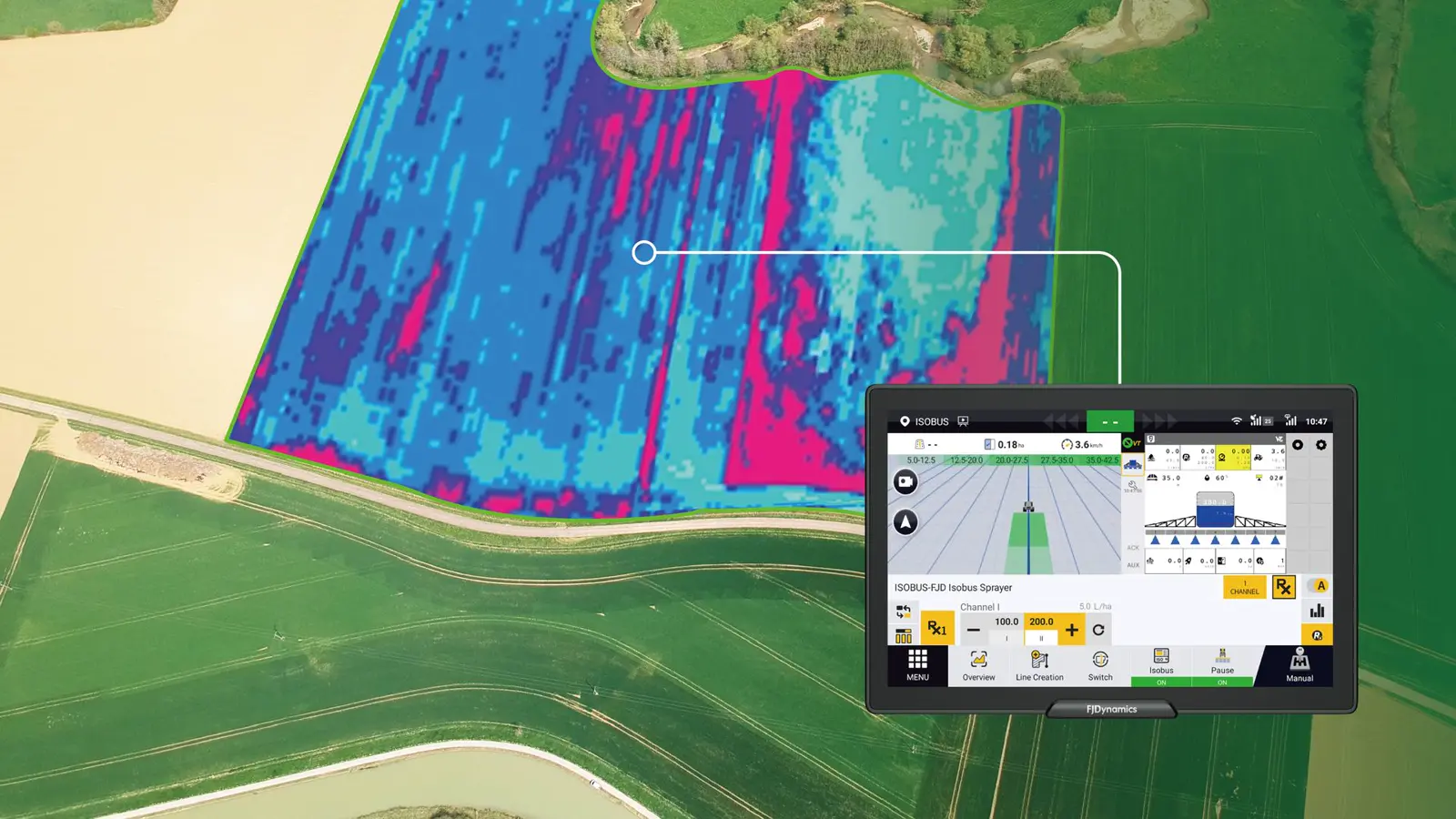
Precision spraying (Annex 4). Annex 4 covers equipment categories that reduce fertiliser use and pesticide drift. For sprayers with automatic section control, the requirements include:
- an electronic application control system,
- automatic adjustment of flow according to travel speed,
- automatic boom section control,
- electronically controlled valves,
- automatic positioning,
- low-drift nozzles, documented by the manufacturer.
Annex 4 also covers other special categories, such as individual nozzle control, PWM technology and variable-rate fertiliser spreaders. Each category has its own requirements.
The FJD ATS combines auto-steering with section and flow control, and helps reduce overlaps and unnecessary applications. One clarification is needed:
The FJD ATS alone does not secure 60%
Annex 4 eligibility is judged on the whole sprayer, its specific configuration and the features of the category. Adding an FJD ATS does not guarantee that the sprayer meets the conditions. The consultant must check the official data of the sprayer’s manufacturer and the compatibility of the whole installation.
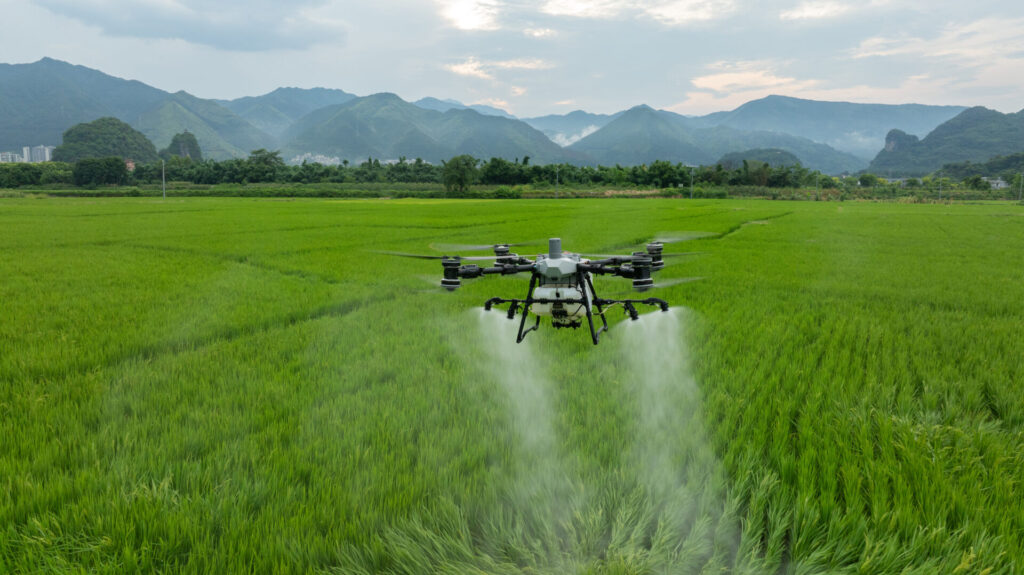
DJI AGRAS agricultural drones. There is a clear distinction between applying plant protection products and fertiliser applications.
- Spraying plant protection products: Joint Ministerial Decision 207871/6.8.2026 (Government Gazette B 4988/2026) expressly excludes the purchase of unmanned aircraft for applying plant protection products. Buying a DJI AGRAS to spray plant protection products is not subsidised under these Plans.
- Fertilising drones: according to the Ministry of Rural Development and Food Frequently Asked Questions of 22 October 2026, UAVs for fertiliser applications can be considered as eligible investments. You must document exclusive eligible agricultural use, the lawful operation of the system and compliance with the regulatory framework for unmanned aircraft systems.
The Ministry also clarifies that, for the usual maximum take-off mass categories, an operator certification procedure by the Hellenic Civil Aviation Authority is required, and that the relevant documents are submitted with the payment request. The procedure takes time and should be planned early.
Watch the support rate for fertilising drones
Fertilising UAVs are not part of the special categories of Annexes 3 and 4, so they do not get the higher 60% rate of those categories, even if they have variable-rate application, digital maps or automated control. Because DJI AGRAS are multi-purpose platforms (spraying and spreading), the eligibility of a specific configuration should not be taken for granted. Ask your consultant or the competent authority for written confirmation before any purchase.
3. Watch when the investment starts
This is one of the most important points of the call. As a rule, investments are carried out after the support application is submitted. As an exception, physical and financial implementation is allowed from 1 June 2026, provided that specific limits are met.
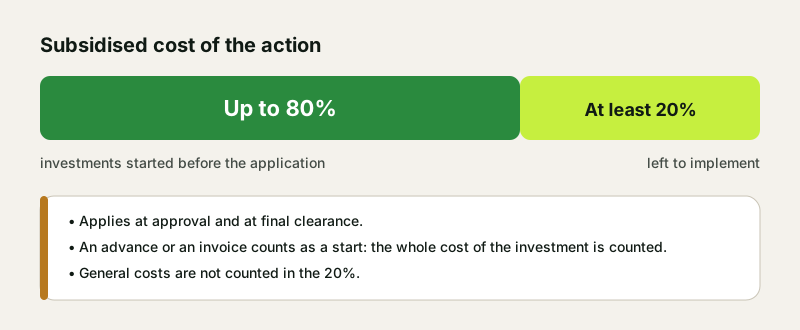
Under the amendment of Joint Ministerial Decision 293292/12-11-2026, the subsidised cost of investments that started before the application must not exceed:
- 80% of the total subsidised cost of the action at approval, and
- 80% of the total subsidised cost that is finally cleared when the plan is completed.
At the same time, at least 20% of the total subsidised cost must remain to be implemented. General costs, as provided in the relevant provision, are not counted in this 20%.
When is an investment considered started? Any act of physical or financial implementation before the application is submitted counts as a start. This includes, among other things:
- paying any part of the price as an advance,
- issuing a related invoice or other document,
- any other act of physical or financial implementation of that investment.
If an investment counts as started, the whole subsidised cost of the investment is counted towards the 80% limit, regardless of how much has already been paid. Also, costs incurred before the inclusion decision are at the investor’s sole responsibility and create no co-financing obligation for the EAFRD.
Our recommendation: do not pay an advance, pay in full or issue an invoice before you have discussed that specific cost with your consultant. A wrong timing decision can affect the whole investment plan.
4. Gather quotations and technical documentation
For every item of equipment in the investment plan there must be clear, official data. The quotation describes exactly:
- manufacturer and model,
- the specific configuration and equipment,
- price and an itemised description of the cost,
- any required accessories or additional parts.
The file must include the manufacturer’s official datasheets, especially when eligibility depends on specific technical features. For the FJD AT2 Ultra, AT2 Max, AT2 and AT2 Lite we can provide the technical data and a quotation. For precision spraying equipment, the documentation of the sprayer itself is also reviewed, according to its Annex 4 category.
5. Collect the supporting documents
There is no single list for all cases. The exact file depends on the beneficiary, the intervention, the type of investment and the characteristics of the holding. Your consultant will set the required documents based on the call and its amendments. For fertilising drones, plan early for the documents on lawful operation and operator certification, where required.
6. Submit through OPSKE
Submission is only electronic, through the Integrated State Aid Information System (OPSKE), and must be completed by 3 February 2027, 13:00. Before final submission, check that:
- all required fields are filled in,
- the required documents are attached,
- the quotations match the data of the investment plan,
- the technical features of the equipment are documented.
7. Evaluation, implementation and payment request
Applications are assessed in a comparative procedure, according to the selection criteria and the available funds. Submission does not mean automatic approval: do not take the investment for granted before the inclusion decision. After inclusion, the beneficiary carries out the investments according to the approved plan and its deadlines. Aid is paid on a documented-cost basis, after the costs have been incurred and paid, and certified by the competent bodies.
Checklist before you submit
- An admissible 2025 Single Aid Application has been submitted.
- The participation conditions and any open issues from earlier investment plans have been checked.
- A consultant has been chosen.
- The investment plan is defined and the support rate has been calculated.
- Each investment is matched to the right eligibility category.
- For an auto-steering system, 100% ownership of the tractor at submission is confirmed.
- Official datasheets for the specific models and configurations have been collected.
- Written, itemised quotations are in hand.
- The 80% limit for investments started before the application has been checked, both at approval and at final clearance.
- The 20% that must remain to be implemented has been planned.
- Operator certification for fertilising UAVs has been scheduled, where required.
- The application is scheduled for submission in good time, before 3 February 2027, 13:00.
Frequently asked questions
When and where do I submit the application?
Applications are submitted electronically in OPSKE, from 10 November 2026 until 3 February 2027, 13:00. The system closes on time, so plan your submission weeks earlier.
I did not submit a Single Aid Application in 2025. Can I still take part?
The amendment of 16 November requires an admissible 2025 Single Aid Application as a participation condition. If you do not have one, ask your consultant to check your case before you incur any cost.
I already own a tractor. What does an auto-steering system need to be subsidised?
It must be a retrofit system with high-precision GPS, real control of the steering wheel and documented accuracy of ±3 cm or better. In addition, you must own 100% of the tractor when you submit. The base rate for this category is 60%.
Which FJD system suits my machine?
It depends on the machine and the work you do. The AT2 Lite is the simplest start, the AT2 and AT2 Max add a larger display and ISOBUS capabilities, and the AT2 Ultra is aimed at combine harvesters and premium tractors. Send us the model and year of your machine and we will suggest a configuration and a quotation.
I want a drone for my fields. Can I buy it with a subsidy?
If it is for spraying plant protection products, no: buying such drones is expressly excluded. If it is meant for fertilising, the purchase can be examined under conditions, but without the higher 60% rate of Annexes 3 and 4. It needs documentation of exclusive agricultural use and operator certification.
My sprayer is an older one. Is adding an FJD ATS enough for 60%?
Not on its own. Annex 4 judges the whole sprayer and the features of its category. The ATS helps with section and flow control, but the consultant must check the whole installation.
My supplier gave me a quotation and asks for an advance. What should I watch for?
Do not pay, and do not ask for an invoice, before you talk to your consultant. An advance or an invoice before the application counts as the start of the investment, and then its whole cost counts towards the 80% limit.
Before you choose equipment, talk to FLYDROPS
The right choice starts from the real needs of the holding and from understanding the technical requirements of the call. FLYDROPS is an official DJI Agriculture and FJDynamics dealer in Northern Greece. We can give you itemised quotations and the manufacturer’s technical data for the equipment you are considering.
Ask for information or a quotation, or call +30 2391 301149 or write to info@flydrops.gr.
Read also
- 2026 Farm Improvement Plans: what applies to tractor navigation systems and agricultural drones
- What is RTK in farming
- Is a spraying drone worth it? DJI AGRAS buying guide
Sources: Call 229623/8-9-2026 and first amendment (Special Service for Rural Development) · Joint Ministerial Decision 207871/6-8-2026, Government Gazette B 4988/2026 · Joint Ministerial Decision 293292/12-11-2026, Government Gazette B 6871/16-11-2026 (National Printing Office) · Ministry of Rural Development and Food, Frequently Asked Questions on interventions Π3-73-2.1, Π3-73-2.2 and Π3-73-2.6, 22-10-2026.
This article is for information and is based on the decisions and clarifications in force on 19 November 2026. It does not replace the study and eligibility check by the competent consultant. The final eligibility of each cost, the supporting documents and the support rate are set by the applicable framework and the assessment of the competent authority.