Case studies by crop · Precision farming
Rice: variable-rate fertilization
DJI Agriculture case study, collected by FLYDROPS.
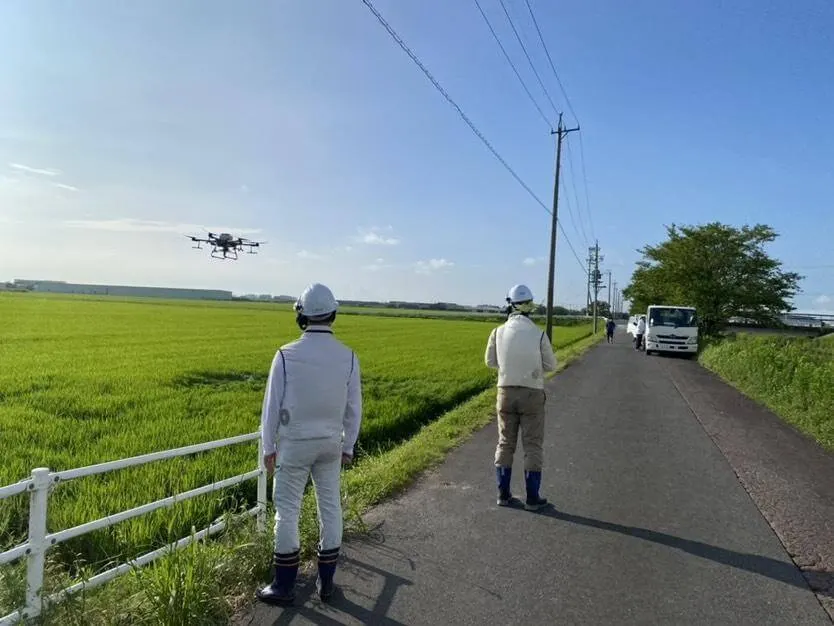
In Gifu, Japan, DJI and Yanmar tested variable-rate fertilization in rice: a multispectral drone mapped the field and an Agras T30 spread the dose by zone. The field that started in worse condition gave 8% more rice with about 80% of the fertilizer quantity.
At a glance
| Location | Kaizu, Gifu Prefecture, Japan |
|---|---|
| Crop | Rice (Hoshijirushi variety) |
| Drone | DJI Phantom 4 Multispectral for mapping, DJI Agras T30 for spreading |
| Software | DJI Terra (prescription map) |
| Trial | Two fields: 3.11 ha variable rate and 3.43 ha fixed rate; July–November 2022 |
| Partners | DJI Agriculture Japan, Yanmar, a local producer |
The study uses the T30, an earlier generation. The current range is DJI Agras T100, T70P, T55 and T25P; find which one fits your acreage or compare the models.
The challenge
When fertilizer is spread evenly across a whole field there is a risk of over-fertilizing: nitrogen burn on seedlings, lodging later on, lower quality and waste. Prescription maps from satellite images depend on weather, revisit frequency and low resolution, while a tractor in a mature crop damages it and gets stuck in mud.
What was done
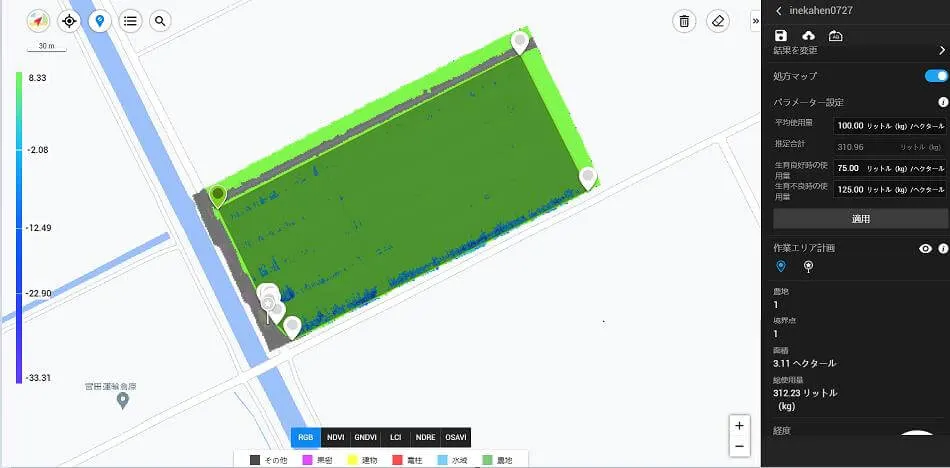
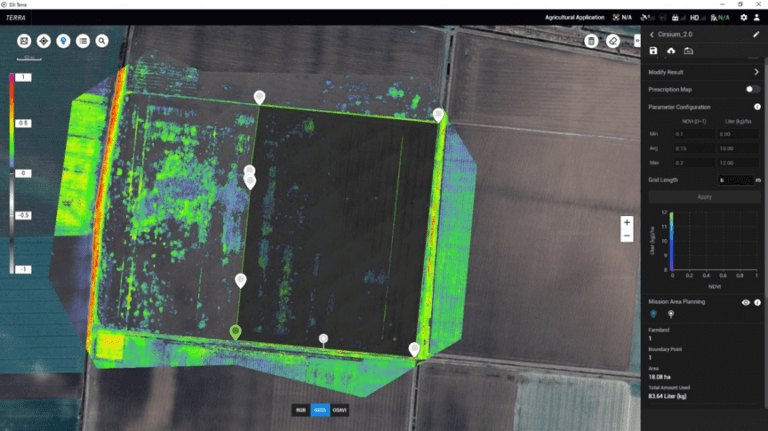
The trial ran on two fields. In the first step, the Phantom 4 Multispectral collected images and DJI Terra produced a prescription map. In the second, the Agras T30 spread the fertilizer at a height of 2 m:
- Variable rate (3.11 ha): 75 kg/ha in good growth, 100 kg/ha average, 125 kg/ha in poor growth; average 100 kg/ha, speed 13.8 km/h.
- Fixed rate (3.43 ha): 100.1 kg/ha, speed 25.2 km/h.
The map showed that the variable-rate field was in worse and more uneven condition than the other.
The results
| Measure | Variable rate | Fixed rate |
|---|---|---|
| Yield | 10,158 kg/ha | 9,381 kg/ha |
| Fertilizer cost | 22,296 JPY/ha | 24,829 JPY/ha |
| Fertilizer quantity | About 80% | 100% |
The numbers come from the study and relate to that specific application.
The study sums up: a saving of 2,533 JPY/ha (about 18.5 USD) and 777 kg/ha extra yield. Two weeks later the RGB, NDVI and GNDVI images showed more even colour, as the multispectral drone had identified growth differences and the spreading followed them. This is a trial on two fields, not a statistical proof.
What it means for Greece
Greece grows rice, mainly around Thessaloniki and Serres, but the method applies more generally: first a growth map, then a dose per zone. The matching drone in our range is the Mavic 3 Multispectral, and we offer a VRA map and multispectral analysis service if you do not want to buy equipment. Fertilizer is spread by the models with a spreading system, for example T100, T70P and T55. The numbers come from two fields in Japan.
Rules and responsibilities
The study is about fertilizing and mapping, not plant protection products. Drone flights are always subject to the competent aviation authority’s rules; check the requirements before you plan work in your own field.
See also
Want to see what this means in your own field? Request a quote or call (+30) 2391 301149 and we will recommend the right setup.
DJI Agriculture case study, “Boost Rice Yield by 8% with 20% Less Fertilizer: Variable-Rate Fertilization with DJI Multispectral Drone” (20 December 2022). Translated and adapted by FLYDROPS. Results depend on the conditions of each field. Read the original.
See also
Application case studies by crop
Contact
Let’s talk about your fields.
Tell us what you grow and what you want to achieve. We’ll recommend the right equipment and send you a quote.