Short answer
A four-year Greek study (2021–2024, journal Agronomy, 2025) found that targeted bait spraying by drone can keep active olive fruit fly infestation at levels comparable to ground spraying (4.6–7.8% with a drone, 5.3–8.4% with ground application, 14.2–22.5% in untreated groves), using far less water. One caution: the study ran under special approvals with one specific drone, and it is not a permit for commercial work. In Greece, aerial application of plant protection products is banned as a rule, and the ban includes drones.
Can an agricultural drone help against the olive’s most important pest?
The olive fruit fly (Bactrocera oleae) is one of the most important pests of Greek olive growing. Its attacks can cause yield losses, damaged fruit and problems with the quality of the olive oil. Controlling it takes good monitoring, the right timing and the right plant protection method.
Not all groves are alike. On steep slopes, terraces, narrow passages or fragmented plots, ground machinery can be slow and hard to bring in. That raises a fair question: can spraying drones offer an effective alternative to bait spraying against the olive fruit fly?
The question is no longer only theoretical. A four-year Greek scientific study, published in 2025 in the international journal Agronomy, compared drone and ground applications in olive groves in four regions of Greece. The results are interesting, and they show both what the technology can do and its limits and the legal framework.
1. The olive fruit fly and why early control matters
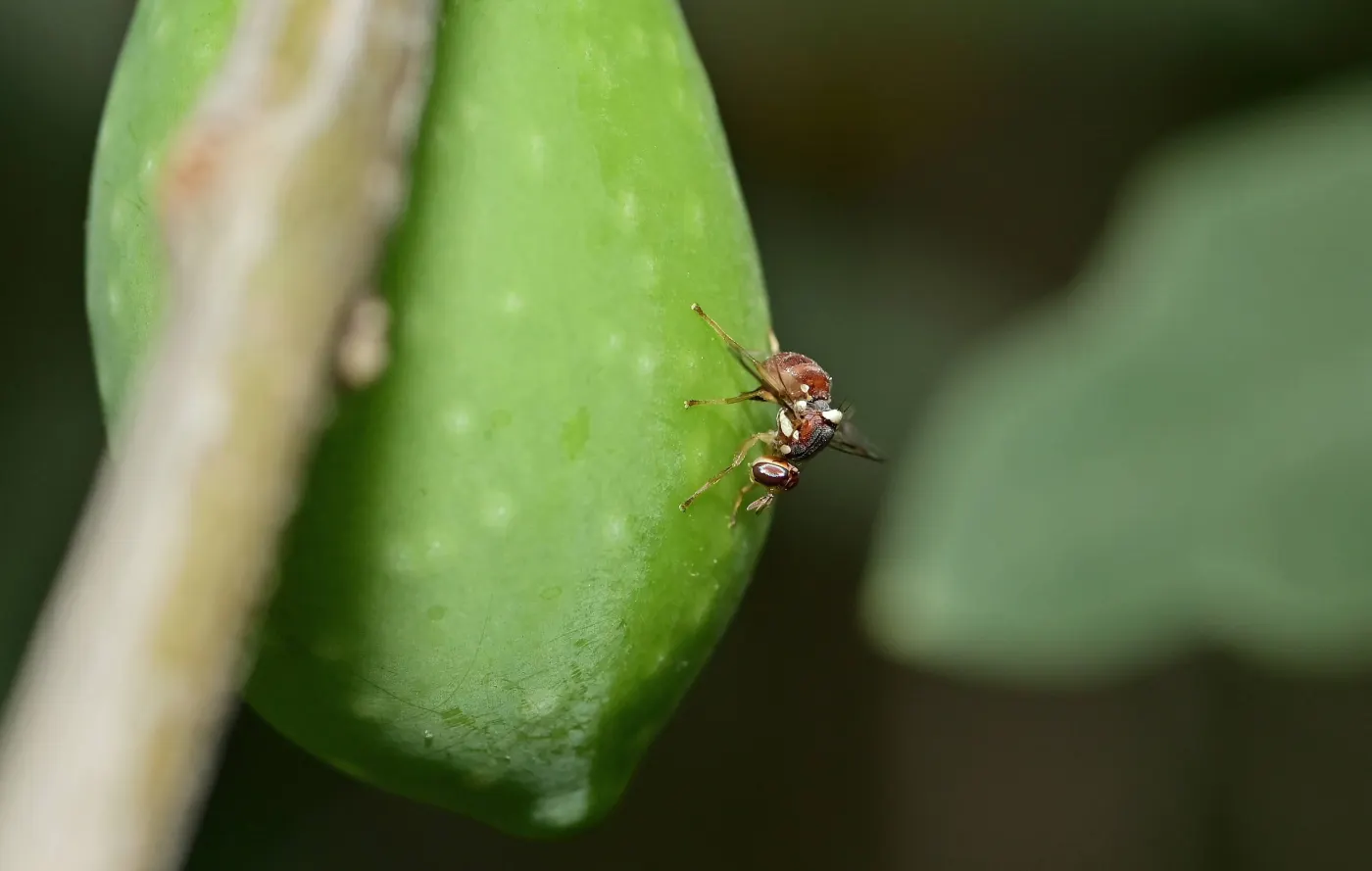
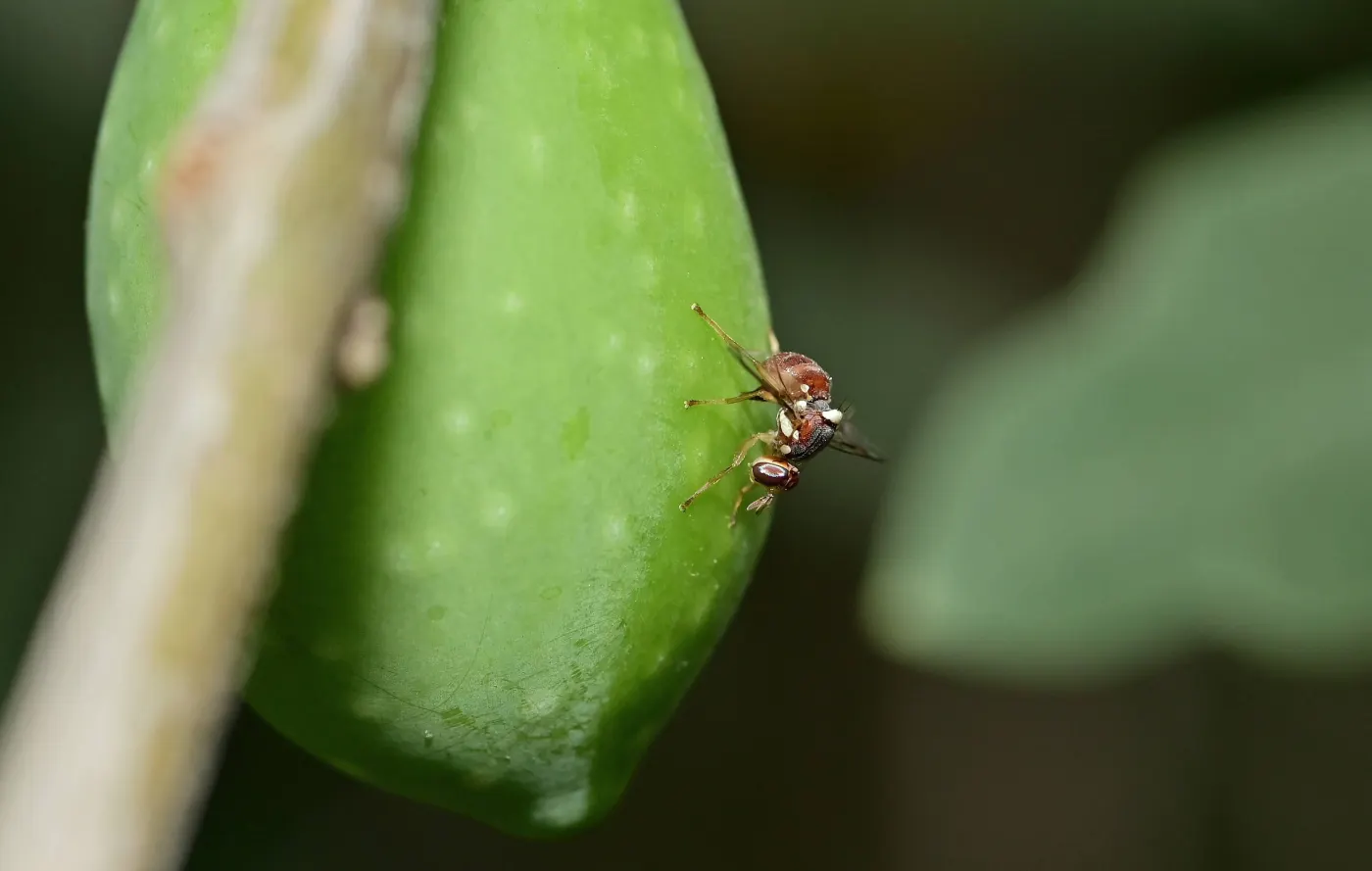
The fly attacks the olive fruit, where the female lays her eggs. The larvae develop inside the fruit and cause damage that affects both the quantity and the quality of the crop. The severity of an attack depends on:
- weather and temperature,
- the variety and the growth stage of the fruit,
- the density of the insect population,
- the history of attacks and the conditions of the particular grove,
- the time of harvest and the plant protection measures applied.
Heavy infestation can lower the quality of the olive oil, among other things by raising acidity and worsening some sensory characteristics. That is why controlling the fly should not follow a fixed spraying calendar: it needs population monitoring, an assessment of the infestation and adjustment to real conditions. In Greece the protection runs through the National Programme for Integrated Olive Fruit Fly Control (“Collective Control of the Olive Fruit Fly”), which started in 1937. It is funded by the Ministry and supervised by the Agricultural Economy and Veterinary Directorates. It monitors the population with a network of McPhail traps and applies three to five bait sprays from the ground, depending on the year, the variety and the climate. The announcements of these services are the first thing a grower should check.
2. The four-year Greek study: drone versus ground spraying
The study Comparative Efficacy of UAVs (Unmanned Aerial Vehicles) and Ground-Based Bait Applications for Olive Fruit Fly (Bactrocera oleae) Control in Greek Olive Orchards was published on 9 September 2025 in Agronomy. It was led by researchers of the Laboratory of Entomology and Agricultural Zoology of the University of Thessaly, with the Hellenic Mediterranean University, regional Agricultural Economy and Veterinary Directorates and the Ministry taking part. It was funded by the national olive fruit fly control programme of the Ministry of Rural Development and Food. The authors also include employees of a drone company and of Elanco Hellas, which they declare themselves in the publication’s conflict of interest statement.
Where and how the research was done
- Regions: Larisa, Zakynthos, Trifylia and Crete, with different soil, climate and terrain.
- Period: 2021–2024.
- Design: in each region three groves of about 2.5 hectares each (25 stremmata) were chosen: one with drone bait application, one with conventional ground application and one untreated control.
- Applications: three per region, between September and October.
- Checks: fruit sampling, 100 olives per grove at each sampling, and recording of climate data.
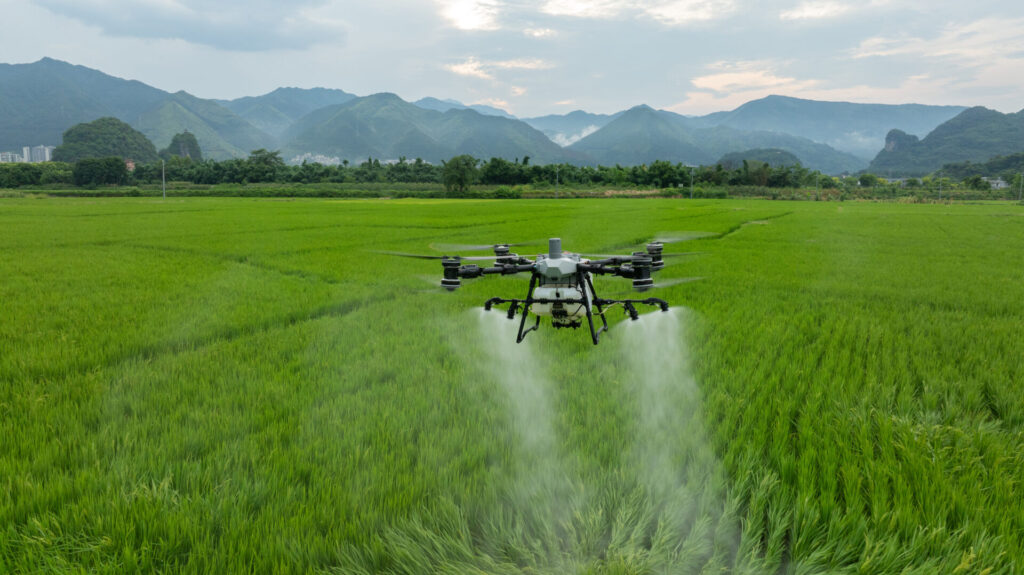
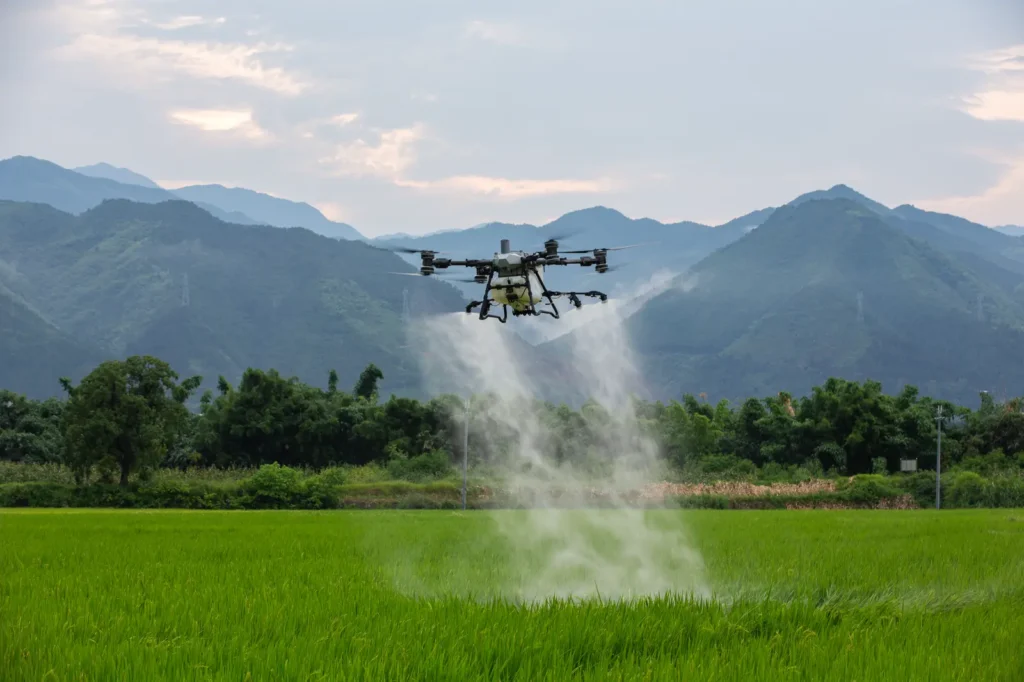
- Drone: a hexacopter with a 10-litre tank, operated by a drone company under authorisation from the Hellenic Civil Aviation Authority. It was not a DJI Agras drone. The newer Agras models have a larger tank and higher capacity.
An important detail: this was not a full wetting of the whole canopy. The application was targeted, a jet of bait on one tree in three, and in a much smaller quantity per tree than the ground application. Bait spraying has a different purpose and different requirements from a cover spray against fungal diseases.
3. What the results showed for fly infestation
The study recorded active infestation of the olive fruit in all three groups of groves:
| Method | Active infestation recorded (range 2021–2024) |
|---|---|
| Untreated groves | 14.2%–22.5% |
| Bait application by drone | 4.6%–7.8% |
| Conventional ground bait application | 5.3%–8.4% |
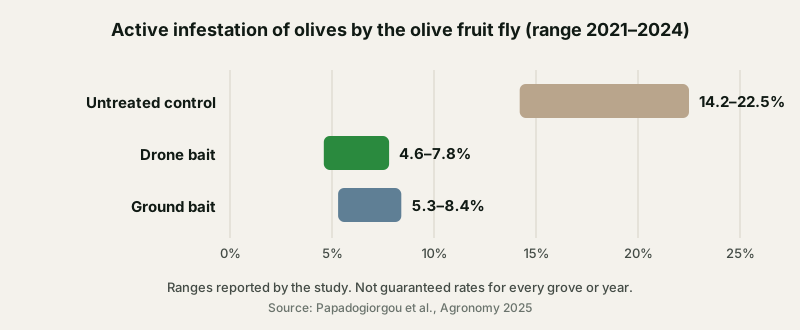
The ranges summarise the values the researchers report for the different conditions of the study. They are not guaranteed effectiveness rates for every grove or every year.
What this means in practice
Both methods were linked to significantly lower active infestation than the untreated controls. In the overall analysis, drone applications gave results equal to, or in some cases better than, ground applications. Effectiveness did vary by year: the differences between methods were clearer in 2021 and 2022, while in 2023 and 2024, with lower infestation pressure, they were not statistically significant.
The conclusion is not that the drone always wins. It is that targeted drone application can, under the conditions of this protocol, control the fly about as well as ground spraying. It is also worth remembering that each region had one grove per method, and that a method should not be judged on a single result.
4. Water savings: one of the most interesting findings
The researchers also recorded the water needed. For an experimental plot of about 2.5 hectares (25 stremmata), they report:
| Method | Water per application on 25 stremmata |
|---|---|
| Drone | 12–23 litres |
| Ground spraying | 150–180 litres |
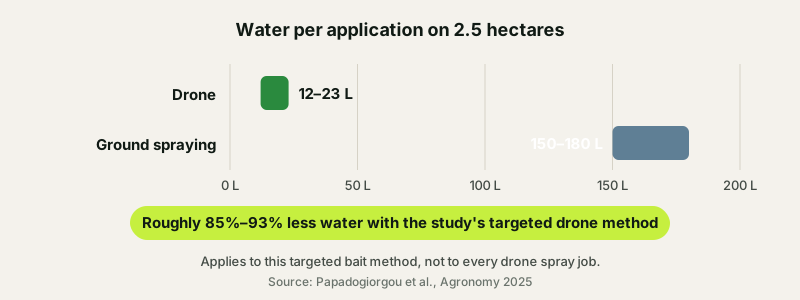
Based on these ranges, water use with the drone was about 85%–93% lower. The difference matters where hauling water is hard or reaching plots takes time and labour. But the figures apply to this targeted bait method and this protocol. They do not mean every drone application needs so little water, or that a drone can replace every type of spraying.
5. The advantages of drones in olive groves
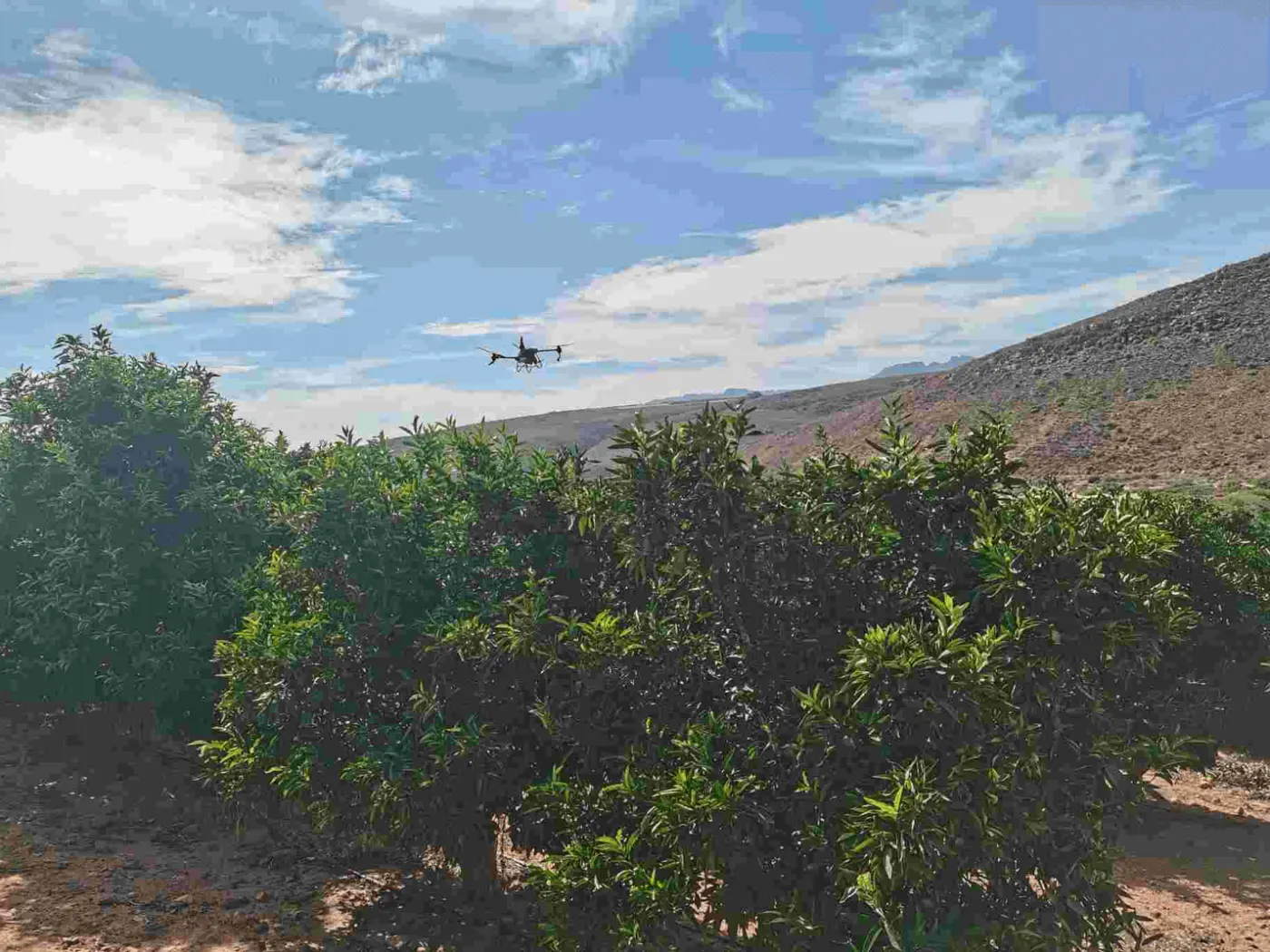
- Access to difficult plots. Slopes, terraces and narrow passages make life hard for ground machines. A drone moves over the plot without driving wheels between the trees.
- Targeted application. When the method allows bait to be placed in a targeted way, the drone flies a preset route and applies at the planned points.
- Smaller liquid volume. The study recorded much lower water use, so less hauling and refilling.
- Planning and repeatability. Automated navigation helps repeat the same job with the same parameters. Real accuracy depends on planning, equipment set-up, weather and the operator’s experience.
6. The limits a grower should know
Technology does not remove the limits of plant protection.
- Tank size and endurance. Smaller tanks than some ground machines and battery changes affect planning, especially on large continuous areas. The researchers say so themselves.
- Weather. Wind, temperature, humidity and rain affect the spray liquid and its effectiveness. The study stresses that the timing of the application must fit favourable weather.
- Terrain and canopy shape. Tree layout, canopy density and relief affect the planning.
- Variation from year to year. Fly pressure and effectiveness do not stay constant, so monitoring and agronomic assessment remain necessary.
- Cost. It depends on the area, the number of applications, the equipment, labour cost and access. There is no single saving figure.
What a Spanish study showed about cover sprays
A study from the University of Seville (Sánchez-Fernández et al., Frontiers in Plant Science, 2024) compared a spraying drone with a standard tractor sprayer in a super-high-density olive grove in Andalusia. The drone, a prototype hexacopter with a 16-litre tank, applied 40 litres per hectare against 800 litres per hectare for the tractor. The drone caused significantly less airborne drift and similar deposits on the soil, but significantly lower deposits on the foliage. The researchers concluded that drones suit bait or systemic products that do not need full coverage, and targeted spraying. This was one trial in one grove with one drone, and the results do not apply to every grove or application.
7. What about peacock spot, cercospora and anthracnose?
The fly is not the only threat. In autumn and winter, rain and humidity favour several fungal diseases. A basic distinction is needed here: the effectiveness of a drone in targeted bait spraying does not prove that it is equally suitable for every application that needs full coverage of the canopy.
| Problem | Cause | What to look for |
|---|---|---|
| Peacock spot | Fungus Spilocaea oleagina | Spots on leaves, early leaf drop, weakened trees. Favoured by humidity, especially in dense canopies and groves with a history of it. |
| Cercospora leaf spot | Fungus Pseudocercospora cladosporioides | Damage to leaves and fruit, early leaf drop. Correct diagnosis matters, as the symptoms resemble other problems. |
| Anthracnose | Fungi of the genus Colletotrichum | Fruit rot and lower oil quality, especially when conditions favour infection during ripening. |
| Olive knot | Bacterium Pseudomonas savastanoi | Galls on branches and shoots. Pruning wounds are an entry point, so clean tools and the timing of work matter. |
| Sooty mould | Fungi growing on the honeydew of insects such as scale insects | A dark coating on leaves and branches. Treatment starts with identifying the cause, not the black coating. |
Do all of these need drone spraying? Not necessarily. They have different biology and different application needs: some need good foliage coverage, others rely on cultural measures, monitoring or another method. The suitability of the equipment, the approval of the product for that method of application and the legislation are checked separately.
8. What is the law on spraying olives with a drone in Greece?
This is one of the most important points. According to the official information of the Ministry of Rural Development and Food (question 18), the application of plant protection products by aerial spraying is banned in Greece (article 23 of Law 4036/2012). The provision is general and does not exempt drones.
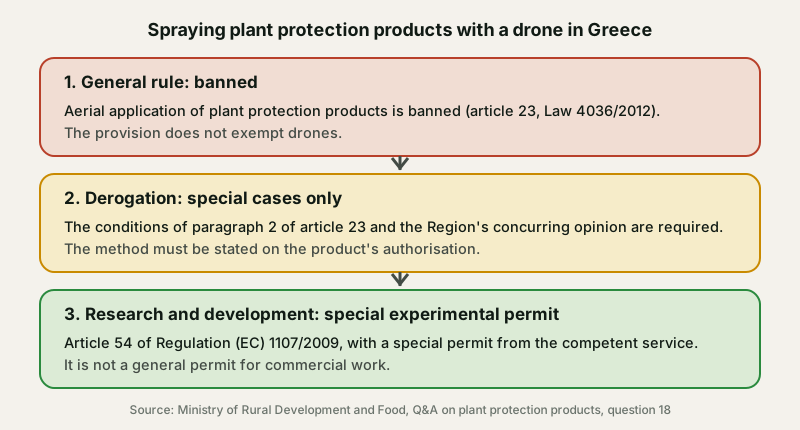
- Derogation: aerial spraying may be allowed only in special cases, when all the conditions of paragraph 2 of article 23 are met and the Region gives its concurring opinion. Even then, the specific method of application must be stated on the product’s marketing authorisation.
- Research and development: drone spraying for research, under article 54 of Regulation (EC) 1107/2009, is done with a special experimental permit from the competent service.
What this means for the olive grower
The Greek study shows the method is of interest agronomically and technically. It does not mean every grower can commercially use a spraying drone for plant protection products. In the research, the flights ran under an operational authorisation from the Civil Aviation Authority and the use of the product had been approved experimentally by the Ministry for 2020–2026. Approval for a research application is not a general permit for equivalent commercial work.
Before any application, get advice from the competent services and your agronomist to confirm what is allowed for that use and period. The Ministry text we used is dated 26 June 2024 (version 4), so check whether a newer one exists. For the wider picture, see our spraying drone buying guide.
9. What drones can do in an olive grove today
The value of agricultural drones is not limited to spraying. Even where applying plant protection products is not allowed, there are other precision agriculture uses. The FLYDROPS services for olive groves and orchards are data capture and analysis services, and they do not include applying plant protection products.
- Mapping the grove: aerial images capture the tree layout, crop cover and the general picture of the plot. For orchards, even on slopes or with uneven planting, see orchard 3D mapping and field mapping.
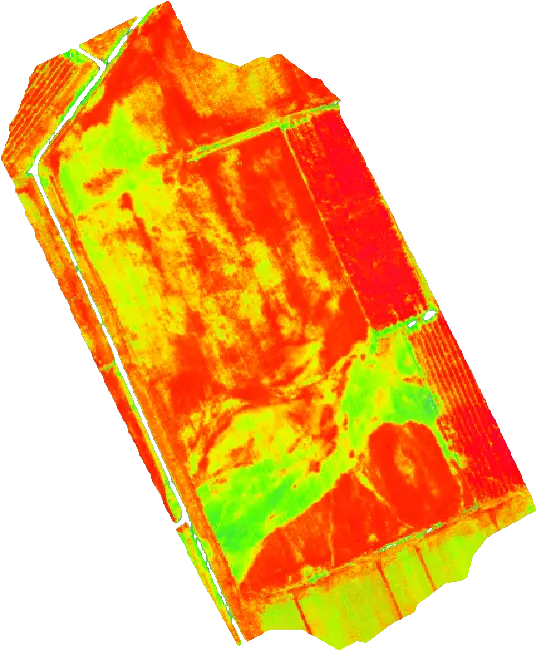
- Multispectral imaging and NDVI: with the right sensors, differences in vegetation between parts of the grove become visible. They show where it is worth going to look, and are not by themselves a diagnosis of disease or nutrient deficiency. See the multispectral imaging service and the article NDVI in farming.
- Better work planning: regularly recording the state of the field helps organise checks and follow differences. That is the core aim of precision agriculture: turning data into useful information.

If you are curious how DJI Agras drones work in orchards in other countries, where the rules differ, see the studies Fruit fly baiting with a drone, Orange orchard: red mites and Peach orchard: aphids. Every country has its own rules, and in Greece the rules above apply.
10. What the grower should do in autumn and winter
- Monitor the fly. Check the available traps, the infestation in the fruit and the official agricultural warnings.
- Inspect the foliage regularly. Look for suspicious spots, early leaf drop and other symptoms that need an agronomic assessment.
- Check the fruit before harvest. The look of the fruit and the history of the grove help assess possible infestations.
- Plan pruning well. Where possible, avoid work that creates wounds in rainy, damp conditions.
- Do not apply plant protection products without a documented need. Diagnosis, choosing an approved product and following the instructions for use are essential.
- Get informed before using new equipment. The technical ability of a drone does not replace the required approvals and legal limits.
Frequently asked questions
Am I allowed to spray my olive grove with a drone in Greece?
As a rule, no. According to the Ministry of Rural Development and Food, aerial application of plant protection products is banned (article 23, Law 4036/2012) and the ban includes drones. A derogation exists only in special cases and with conditions, and research is done under a special experimental permit.
What did the Greek study find about the olive fruit fly?
That targeted bait spraying by drone significantly reduced active infestation compared with untreated groves, with results equal to or better than ground spraying and far less water. The differences between methods were clearer in 2021 and 2022.
Was the study done with a DJI Agras drone?
No. It used a hexacopter with a 10-litre tank, operated by a drone company. The newer Agras models have a larger tank and higher capacity. The study’s results apply to that drone and that method, and do not transfer automatically to other models.
Can a drone do cover spraying against peacock spot or anthracnose?
The fly study does not show that, because it covers targeted bait spraying. A Spanish study even found significantly lower deposits on the foliage with a drone in a super-high-density olive grove. For fungal diseases, the choice of method and product is a matter for an agronomist and the law.
What can a drone do in the grove without spraying?
Mapping, 3D capture of the trees and multispectral imaging, so that differences in vegetation show up and checks in the field can be organised.
Does FLYDROPS map olive groves?
Yes: field mapping, orchard 3D mapping and multispectral imaging, from our base in Koufalia, Thessaloniki. Call us or ask for a quote and tell us the crop, the area and the size.
Conclusion: technology has value when it rests on data and correct use
The four-year Greek study, led by researchers of the University of Thessaly, offers significant evidence on bait spraying against the olive fruit fly by drone. Under the conditions examined, the method achieved results comparable to conventional ground application with a much smaller volume of water, and it is of interest for hard-to-reach groves.
At the same time, the variation from year to year shows that no technology replaces monitoring of the pest, agronomic knowledge and sound planning. And the legal framework remains decisive: scientific evidence for a method does not mean its commercial use is automatically allowed.
At FLYDROPS we follow developments in agricultural drones and precision agriculture, so that we can inform growers responsibly about what the technology can do and what its real limits are.
Want to learn about agricultural drones and mapping your olive grove?
FLYDROPS is an official DJI Agriculture and FJ Dynamics representative, based in Koufalia, Thessaloniki. We can tell you about the DJI Agras range and about mapping, multispectral imaging and precision agriculture. Tell us your crop, your region and how many stremmata you have. Call (+30) 2391 301149 or ask for a quote.
FLYDROPS: together, for smarter farming!
Sources and scientific references
- Papadogiorgou G.D. et al. (2025). Comparative Efficacy of UAVs (Unmanned Aerial Vehicles) and Ground-Based Bait Applications for Olive Fruit Fly (Bactrocera oleae) Control in Greek Olive Orchards. Agronomy, 15(9), 2158. doi.org/10.3390/agronomy15092158
- Ministry of Rural Development and Food, Questions and answers on plant protection products (26/06/2024, version 4), question 18 on application with drones (in Greek).
- Sánchez-Fernández L. et al. (2024). Reducing environmental exposure to PPPs in super-high density olive orchards using UAV sprayers. Frontiers in Plant Science, 14:1272372. doi.org/10.3389/fpls.2023.1272372
Note
This article is for information only and does not replace agronomic advice. Approvals of plant protection products, permitted uses and legal requirements must be checked with the competent authorities before any application.